
Insult to Injury.
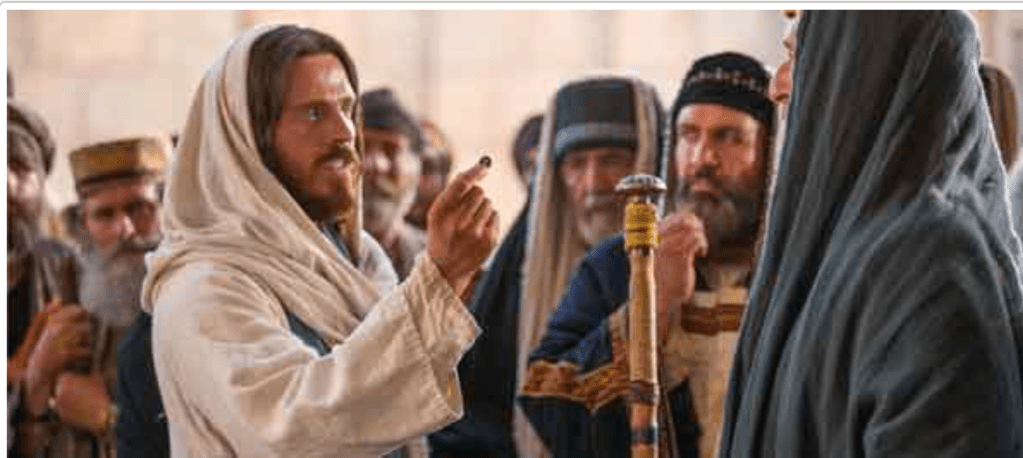
Jesus was offensive. A lot. If I was his disciple back then, I think I would have spent most of the day wincing every time he opened his mouth, especially when we were around religious people.
So in this instance, I don’t know…. maybe it was a “cultural thing,” but I can’t find a reasonable explanation for Jesus spitting directly in someone’s eyes. This story is so stuck in my admittedly overactive imagination that I need to process it on paper (or screen.) The account is just weird, with specifically weird details.
Mark 8:22-26
22 Then He came to Bethsaida; and they brought a blind man to Him, and begged Him to touch him. 23 So He took the blind man by the hand and led him out of the town. And when He had spit on his eyes and put His hands on him, He asked him if he saw anything.
24 And he looked up and said, “I see men like trees, walking.”
25 Then He put His hands on his eyes again and made him look up. And he was restored and saw everyone clearly. 26 Then He sent him away to his house, saying, “Neither go into the town, nor tell anyone in the town.”[c]
“Beit Saida” (“House of Fish”) is in the northern Galilee and Mark tells us that “they brought a blind man to Jesus.” Who are the “They”? It’s been assumed that it’s the townspeople who alerted Jesus to him and there’s no reason to question it. I’ve been thinking for years now that the townspeople (presumably the blind guy’s friends) were concerned for him and just wanted him healed and heard that Jesus was passing through. If they were sincere, however, why did Jesus separate him from them? Did they want to see a miracle for the fun of it? Was this guy being exploited for their amusement? Does it matter? It might.
It turns out that Beit Saida happens to be the hometown of Philip, Andrew and Peter, and Jesus and his disciples were passing through on their way to Caesarea Philipi. The person witnessing the event (we can assume it’s Peter since it’s Mark’s gospel?) was obviously close enough to hear the conversation so he wasn’t one of those “men who look like trees” who are back in the village gate. Was the blind man known to the three disciples and was this an opportunity for them to have their friend or relative healed? Are they the “They”?
We then read that Jesus took him by the hand and led him out of the village.
Stop right there.
Why is that detail in there? Why are we given the visual detail of Jesus taking the guy by the hand? In Jeremiah 31:32 God is talking about the new covenant that will be written on their hearts and that it will “not be like the covenant I made with their ancestors on the day I took them by the hand to lead them out of the land of Egypt…” There’s also a reference to this in the book of Hebrews 8:9. Is this another one of those “stretch out your hand” clues where Jesus is freaking everyone out by using words that only YHVH used?
Apparently the man couldn’t be dealt with “in town” or “within the confines of the cultural surroundings.” It wasn’t a few steps away, it seems. Did they talk along the road? Did Jesus ask him questions or assure him not to worry, to trust him? Did they engage in small talk? Were Peter and Andrew introducing him to their Teacher and telling Jesus what a great guy he was or how he became blind? (We don’t know if he was blind from birth.) The man goes along with it, trusting Jesus to lead him out of the familiar and into what we can assume is unknown territory, outside of his comfort zone.
So they get to the place far enough from the village to satisfy Jesus. The town’s people are watching as Jesus spits on the guys’ eyes, because that’s how optometry worked back then, of course.
Stop right there.
How gross. How seriously gross, with all due respect. Were the guys’ eyes open? Closed? He didn’t “see it coming”, right? Did Jesus warn him, “OK. Don’t panic. I’m going to spit in your eye.” Did he draw up the spit with that throaty sound that guys do before spitting? I’m sorry. I have to ask. The only thing I can find on it is from the Talmud, Bava Basra, 126B in the Gemara after a discussion about rights of the firstborn son (aye chihuahua, another discussion point):
A certain person once came before R. Hanina and said to him, ‘I am sure that this man is firstborn’. R. Hanina said to him, ‘How do you know?’ — The person replied to him: ‘Because when people came to his father, he used to say to them: “Go to my son Shikhath, who is firstborn and his saliva heals’. Might he not have been the firstborn of his mother only [but not of his father]? There is a tradition that the saliva of the firstborn of a father heals, but that of the firstborn of a mother does not heal.
It’s very interesting to note that Vespasian (Roman General, father of Titus, who slaughtered the Jews in Galilee leading to the Tisha b’Av destruction of 70AD foretold by Jesus) is said to have healed a blind man with his spit because of his “partiality with the gods.” This, of course, written by the Roman historian, Tacitus, a few decades after Jesus did his spitting miracle. The winners write, and/or rewrite, history. It still doesn’t answer my question as to the spitting thing. I mean, it’s just… rude to my 21st century mind.
But let’s get back to our story.
Jesus then asks if the man sees anything. The man, of his own volition looks up, and does in fact get some of his vision restored and reports seeing men that look like trees.
“Men like trees.” What’s THAT all about and why isn’t 20/100 vision sufficient for Jesus? This verse has always been used as an excuse for healing that doesn’t come immediately. “Healing is a process” as I’ve been told. And so it is a lot of the time, especially emotional healing. But physical healing? From Jesus himself? Sorry but when did Jesus ever get it wrong or “close enough” when it comes to that? I believe this is the only time in the entire New Testament when Jesus had to keep trying. Excuse me? There’s got to be more.
So as my pastor loves to say, “Let the Bible interpret itself.” So where else do we see “men as trees”? Lots of places, as it turns out. I’ll give you a few but please do a study on your own and be richer for it.
In Psalm 1 the man who doesn’t walk in the way of the wicked is “like a tree planted beside flowing streams that bears fruit in its season.”
Psalm 92: 12: The righteous thrive like a palm tree and grow like a cedar tree in Lebanon…”
Jeremiah 17:8 tells us that the man who trusts in the Lord “will be like a tree planted by water; it sends its roots out toward a stream, it doesn’t fear when heat comes, and its foliage remains green. It will not worry in a year of drought or cease producing fruit.”
Jesus often used the tree metaphor for people, especially when discussing righteous deeds and bearing fruit.
So what do we make of the fact that the blind man saw men who looked liked trees and this was not satisfactory to Jesus, so much so that he had to keep healing him? Something else is going on. As we read on, Jesus does something more and it’s remarkable. He places his hands on the man again and “restores” him. The word is “apokathistemi” and the breakdown basically implies that one is set up as “an authority, ordain, appoint, to make stand, to place in the presence of others, to make firm, establish.” And then Mark tells us that the man “saw everything clearly.”
Stop right there.
Why doesn’t it say that he saw the men clearly, the men who previously looked like trees? When he first sees them the word used is “anthropos” where we get “anthropomorphic” or “anthropology”. So why doesn’t Mark simply say that the blind man saw them, the men/anthropos, clearly? Backing up a bit, the verse says that “Jesus put his hands again upon his eyes and made him look up and he was restored and saw everything clearly.” Jesus made him look up. Jesus made him look beyond or above the men that looked like righteous people. Then Jesus established the blind man firmly. Did he appoint the formerly famous blind guy as a kind of authority? He gave him some kind of wisdom when he restored him.
So what did he see when he looked up as Jesus commanded? He saw “hapas” and it’s made up of two words, the first is Alpha. Yes. Alpha. The first letter of the Greek Alphabet and the name that Jesus identifies himself as four times in the Book of Revelation when he says, “I am the Alpha and the Omega.” The second part of the word is “pas” and it’s translated 748 times as “all” and 170 times as “all things” and only 41 times as “all men”. Even so, “all men” would make sense, too. So he sees “hapas”: the Alpha, and all things. The blind man sees Jesus before all things. (It’s not “all things and Alpha.”)
And here’s where it gets juicy.
He doesn’t just see the Alpha and all things, he sees them clearly. The word is “talaugos” and it’s derived from two words, “telos”, meaning “end, termination, the limit at which a thing ceases to be”, and from the word “auga” meaning “break of day, brightness, radiance, daylight.”
So what is being said here? When Jesus first gains the man’s trust and he starts the healing, the man sees his townspeople, his friends as “righteous”. OK. Maybe they were, maybe not… but hey, the guy was seeing something. Dayenu!!! It would have been enough! But Jesus tosses in a freebie, as it were, perhaps for the sake of his disciples who (sheer conjecture here) had a vested interest in the man. Jesus takes him beyond physical healing and gives him revelation. He gives the man discernment beyond what he had hoped or imagined; immeasurably more; just because He can. (Ephesians 3:20)
Curiously, to end the encounter, Jesus tells the man to go home and not to go back to the village nor tell the people there about any of this. Surely word would get out that the man was healed, so that can’t be what Jesus is saying. It would be like putting a purple hat on him and saying, “Now don’t tell anyone you’re wearing a purple hat.” So perhaps it’s the second thing, the less obvious thing that Jesus wants the man to withhold, vis a vis, that revelation. As I said earlier, he gave him some knowledge that wasn’t to be shared with the villagers. Why?? Isaiah 46:10 says “I make known the end from the beginning…” However, it apparently wouldn’t be beneficial to the people of Bethsaida for the man to tell them their end. And maybe Jesus wanted to disclose that himself. As a matter of fact, he does, and he doesn’t mince words:
“Woe to thee, Chorazin! Woe to thee, Bethsaida! Because, if in Tyre and Sidon had been done the mighty works that were done in you, long ago in sackcloth and ashes they had reformed.” Matthew 11:21 and Luke 10:13
It sounds like the people of Bethsaida had seen many amazing miracles, so maybe they really were exploiting this blind man and Jesus for sport, as entertainment, a reality show. Maybe Jesus had to reveal to him that those “trees” weren’t as righteous as they appeared and they were headed for judgement. Perhaps they had the appearance of compassion but were placing bets. Who knows. We only know that Jesus wasn’t happy with them.
Have you ever allowed Jesus to take your hand and lead you out of your cultural comfort zone? I’ve been in that process for a few years. It’s unnerving.
The Jesus Eye-Wash
Have you ever been offended by Jesus “spitting in your eye” and showing you something about your motives, or the motives of others? My motives are usually humiliating when brought into the Light when Jesus spits in my eye to show me how unbelievably selfish and judgmental I am. Maybe it takes his wash (or back-wash) to get that log out of my eye.
Have you ever been told not to go back to those who only knew you as blind? And worse, has God ever revealed to you their end if they stay stuck in their unrepentance? True revelation doesn’t lead to a self-righteous and judgmental attitude; it brings deep grieving, compassion, and intercession.
Jesus told the man to go home. Clearly, the villagers weren’t his home.
Where was “home” for him?
Where is “home” for you, when Jesus offends you?
Posted in: Uncategorized

 HaZayin.com